Open Projects
Türkçe: README.tr.md
Building-Level Postcodes: A Full Address from a Postcode and a Door Number
Summary
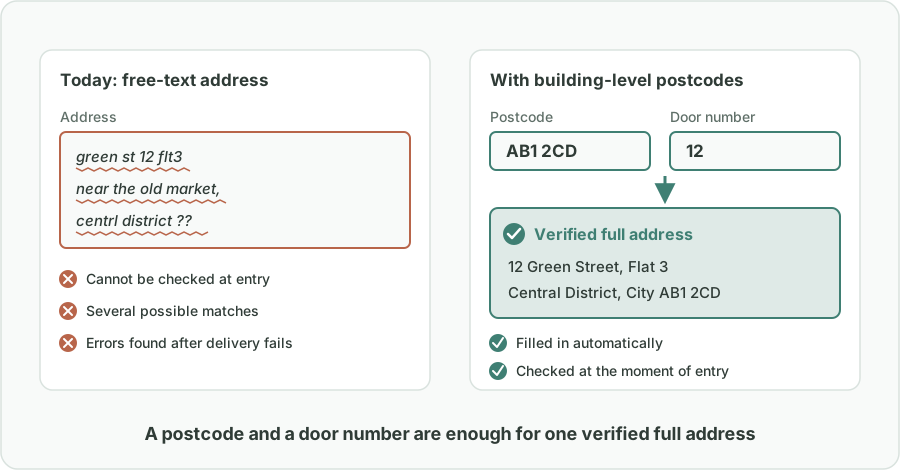
In many countries a postcode covers a whole district or neighborhood, so addresses are typed as long free text and are often wrong or incomplete. This proposal gives each building (or a small group of buildings) its own unique postcode, as in the UK system. Then a postcode plus a door number is enough to find the full address. Forms can validate and autofill addresses, and the costly work of correcting bad addresses, which today supports a whole industry, is largely no longer needed.
Problem
- When a postcode covers a large area, it cannot identify a specific address. People have to type the street, building name, number, neighborhood and district as free text.
- Free-text addresses are written in many different ways: spelling mistakes, abbreviations, missing parts, old street names. The same building can appear in dozens of forms.
- Because addresses cannot be validated at the moment they are entered, errors are discovered only later, when a parcel does not arrive, a bill goes to the wrong place or a service cannot find the house.
- Significant effort and money go into fixing these errors afterwards. Companies are set up just to clean and correct address data, and organizations run large address-correction projects. All of this is a waste caused by a missing system.
- In emergencies, an unclear address costs time exactly when time matters most.
Proposed Solution
Introduce a detailed postcode system in which the postcode points to a building, not to a whole area:
- One postcode per building: each building, or a small group of neighboring buildings, gets a unique postcode. Postcodes stay regionally meaningful: the first part shows the wider area, the last part narrows it down to the building.
- Postcode plus door number is enough: from these two pieces of information, the full official address can be found without typing anything else.
- One public address reference: the postcode authority maintains an official list that links each postcode to its buildings and full addresses, kept up to date as buildings are added, renamed or demolished.
- Validation and autofill everywhere: public services, online shops, banks, couriers and utilities can check the address when it is entered and fill it in automatically, so errors are caught at the start.
- Free text becomes the exception: free-text entry remains only for rare cases, not as the default.
How It Works
| Step | Today (area-level postcode) | With building-level postcodes |
|---|---|---|
| Entering an address | Type the full address as free text | Enter postcode and door number |
| Checking it | Not possible at entry | Checked instantly against the official list |
| Result | Many spellings for the same place | One standard, verified address |
| Fixing errors | After delivery fails, often by specialist firms | Rarely needed |
| Emergency response | Time lost interpreting the address | Building identified directly |
flowchart TD
    Enter(["User enters postcode"]) --> Lookup["Official list returns the buildings for this postcode"]
    Lookup --> Door["User enters or picks the door number"]
    Door --> Found{"Address found?"}
    Found -->|Yes| Fill["Full address filled in automatically and verified"]
    Found -->|No| Check["User is asked to check, or reports a missing address to the postcode authority"]
    Fill --> Use["Used by shops, couriers, public services and emergency response"]
Implementation & Phasing
- Design and official address reference: the national postcode authority, with municipalities and the land registry, designs the building-level scheme and builds the official list linking postcodes to buildings and addresses.
- Pilot region: assign building-level postcodes in one city or region and test them with public services, couriers and online shops.
- Nationwide rollout: extend the scheme region by region. Old postcodes remain accepted during a transition period.
- Adoption across services: public forms and major private services switch to postcode plus door number entry with validation and autofill.
- Continuous maintenance: new buildings get a postcode as part of the building permit and address assignment process, so the list stays current.
Stakeholders & Benefits
- Citizens: faster, easier forms and fewer lost deliveries and misdirected letters.
- E-commerce and logistics companies: fewer failed deliveries and less money spent on cleaning address data.
- Postal service and couriers: clearer routing down to the building.
- Public services and utilities: accurate records for billing, notices and service delivery.
- Emergency services: quicker, more reliable identification of where help is needed.
- The wider economy: resources now spent on correcting addresses can go to productive work, supporting digital government.
Risks & Mitigations
| Risk | Mitigation |
|---|---|
| People and businesses have to learn new postcodes | Transition period where old postcodes still work; postcodes shown on building plates and official documents |
| The official list becomes out of date | Postcode assignment tied to building permits and address changes; easy reporting of missing addresses |
| Cost of redesigning the postcode system | Pilot region first, then phased rollout |
| Rural or scattered buildings are hard to group | Flexible rule: one building or a small group, decided locally |
| Some services keep using free text | Public services lead the change; validation offered openly so private services can adopt it easily |
Keywords: postcode, postal code, address validation, address autofill, digital government, e-commerce, logistics, emergency response, address data quality
Support This Work
If you find this idea useful, you can support the author’s open work through GitHub Sponsors.
Origin
Originally proposed by Merih İlgör (June 2025); published here as an open project idea.
License
This work is licensed under CC BY-NC-SA 4.0 for non-commercial use; see LICENSE. Commercial use requires a revenue-share agreement; see COMMERCIAL-LICENSE.md. Modified versions may not be sold or transferred to third parties as new ideas, and patent-like rights are reserved; see COMMERCIAL-LICENSE.md.