Open Projects
Türkçe: README.tr.md
Floating Solar on Reservoirs: Saving Water and Generating Energy on the Same Surface
Summary
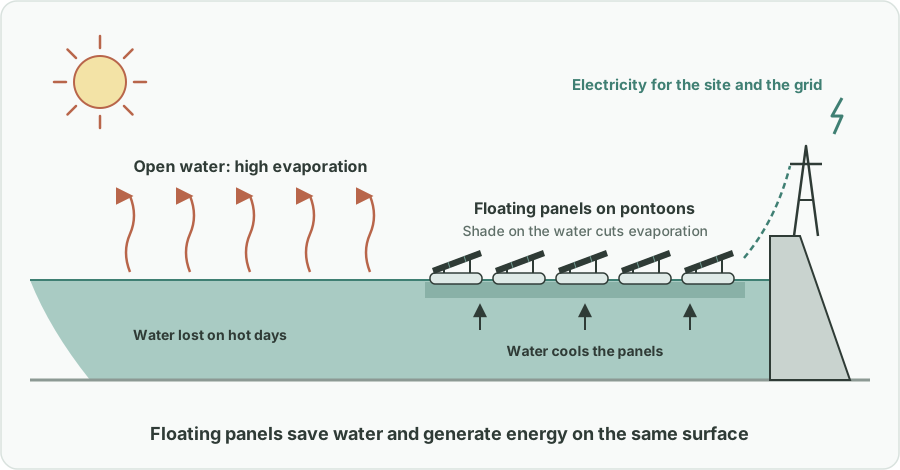
On hot summer days, dam reservoirs and the open ponds of water-treatment plants lose a large amount of water to evaporation. This proposal places floating solar panels on pontoons over part of these water surfaces. The panels shade the water and reduce evaporation, while producing clean electricity at the same time. One installation delivers two gains, water and energy, without taking up any land, and the water underneath keeps the panels cooler so they work more efficiently.
Problem
- In hot, dry periods, open water surfaces such as dam reservoirs and treatment-plant ponds lose a significant amount of water to evaporation, exactly when water is most needed.
- As heat waves become more frequent and longer, this loss becomes a growing risk for the sustainability of water supplies, especially in regions under water stress.
- Solar power needs space. Ground-mounted solar farms compete for land that could be used for agriculture or left as natural habitat.
- Dams and treatment plants use energy themselves (pumping, treatment, operations), and those costs keep rising.
- Today, the water surface and the energy need are treated as separate problems, although one surface can help solve both.
Proposed Solution
Install floating solar systems on selected water surfaces that belong to the water infrastructure:
- Where: dam reservoirs and the open ponds and basins of water-treatment plants, starting with those in regions under water stress.
- How much: panels cover part of the water surface, not all of it. The share is chosen for each site so that water quality, ecology and the site’s normal operation are protected.
- Water gain: the shaded surface loses less water to evaporation, especially on the hottest days.
- Energy gain: the panels produce clean, locally generated electricity. It can first cover the site’s own energy needs (pumping, treatment), with any surplus fed to the grid.
- No land use: generation happens on water that is already dedicated to infrastructure, so farmland and natural areas are left untouched.
- Better efficiency: the water surface cools the panels, which helps them produce more energy than they would on hot ground.
How It Works
| Open water surface (today) | With floating solar | |
|---|---|---|
| Evaporation on hot days | High, water is lost | Lower under the shaded area |
| Energy | None | Clean electricity for the site and the grid |
| Land used | None | None, the panels float on the water |
| Panel temperature | Not applicable | Cooled by the water, better efficiency |
| Site operating costs | Full energy bill | Partly covered by own generation |
flowchart LR
    Sun(["Summer sun"]) --> Panels["Floating panels on pontoons"]
    Panels --> Shade["Shade on the water surface"]
    Shade --> Less["Less evaporation: water saved"]
    Panels --> Power["Electricity generated"]
    Power --> Site["Covers the site's own energy needs"]
    Power --> Grid["Surplus fed to the grid"]
    Water["Water below"] -->|"Cools the panels"| Panels
Implementation & Phasing
- Site selection and feasibility: identify reservoirs and treatment ponds where evaporation losses are high and conditions are suitable, and carry out feasibility studies, including water-quality and ecological assessments.
- Pilot projects: install floating solar on a limited area at a few sites and measure the real water savings, energy output and any effects on water quality and wildlife.
- Expansion to water-stressed regions: based on the pilot results, extend the approach first to regions where water security is most at risk.
- Standard practice: consider floating solar as a regular option when planning new reservoirs, treatment plants and renewable-energy programs.
Stakeholders & Benefits
- Water utilities and dam operators: less water lost from reservoirs and lower energy bills.
- Energy authorities and grid operators: new clean, local generation capacity without new land.
- Farmers and rural communities: farmland is not taken for solar farms, and more water stays available.
- Environmental agencies: renewable energy without clearing natural areas, with monitoring built in from the pilot stage.
- The public: better water security and energy supply security, especially during heat waves.
- Investors and industry: a clear, measurable project model that combines two public goods.
Risks & Mitigations
| Risk | Mitigation |
|---|---|
| Effects on water quality or aquatic life | Partial coverage only, ecological assessment before installation and monitoring during operation |
| Interference with dam or treatment-plant operations | Site-by-site design with the operator; areas needed for operations stay free |
| Storms, waves and changing water levels | Design for each site’s conditions, verified in the pilot stage |
| Upfront cost | Pilot first, then expansion based on measured water and energy gains |
| Conflict with other uses of the water (fishing, recreation) | Consult local users and choose the covered area accordingly |
Keywords: floating solar, floating photovoltaics, dam reservoirs, water treatment, evaporation, water security, renewable energy, energy supply security, climate adaptation, land use
Support This Work
If you find this idea useful, you can support the author’s open work through GitHub Sponsors.
Origin
Originally proposed by Merih İlgör (January 2026); published here as an open project idea.
License
This work is licensed under CC BY-NC-SA 4.0 for non-commercial use; see LICENSE. Commercial use requires a revenue-share agreement; see COMMERCIAL-LICENSE.md. Modified versions may not be sold or transferred to third parties as new ideas, and patent-like rights are reserved; see COMMERCIAL-LICENSE.md.