Open Projects
Türkçe: README.tr.md
Hood-Open Driving Warning: Preventing Accidents Caused by an Unlatched Hood
Summary
Vehicles already warn the driver when a door or the trunk is left open. The hood (bonnet) deserves the same treatment. This proposal makes a hood-open warning a standard safety feature: the vehicle tells the driver when the hood is not fully closed and locked, and the warning becomes more insistent once the vehicle starts moving. The aim is simple: a hood that was left open should never fly up while driving, block the driver’s view, and cause an accident.
Problem
- The hood is opened often: checking oil and coolant, topping up washer fluid, jump-starting, servicing, car washes. It is easy to close it only halfway, or to drop it without it fully locking.
- From the driver’s seat, a hood that is not fully locked is hard or impossible to notice. Its edge sits low and looks normal while the car is parked.
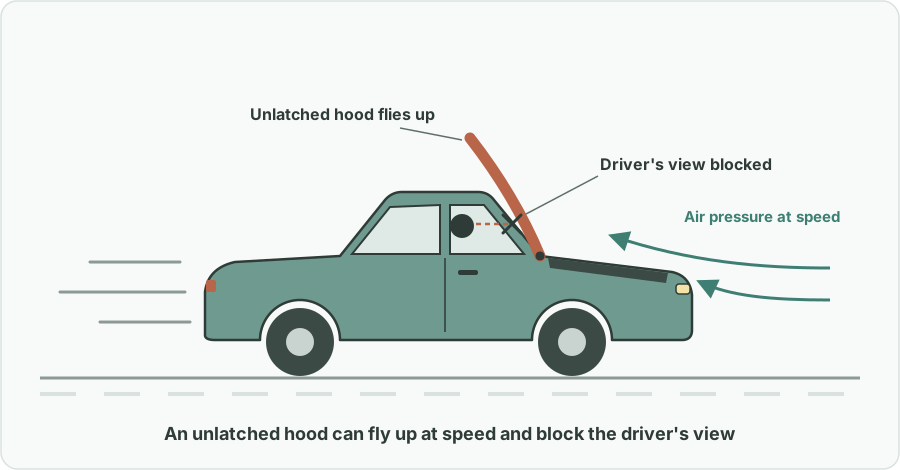
- At driving speed, air pressure can lift an unlocked hood. If it flies up, it suddenly blocks the entire windshield. The driver loses visibility with no warning, which can lead to panic braking, loss of control and collisions, putting the occupants and other road users at risk.
- Most drivers are used to the door-open warning, but the hood is often left out of this protection, or the warning is missing on many vehicles.
Proposed Solution
Make the hood part of the same “open closure” warning logic that already exists for doors:
- Detection: the vehicle knows whether the hood is fully closed and locked. It also recognizes a half-closed state (resting on the safety catch but not fully locked) as “not closed”.
- Warning when parked: when the vehicle is started or the ignition is switched on with the hood not fully locked, a clear dashboard warning (icon plus message) appears, exactly like the door-open warning.
- Escalating warning while moving: if the vehicle starts moving with the hood not fully locked, the warning escalates: an audible alert that continues and a more prominent message telling the driver to stop safely and close the hood.
- No sudden intervention: the system warns but never brakes or stops the vehicle by itself, so it does not create a new hazard in traffic.
How It Works
| Situation | What the driver experiences |
|---|---|
| Hood fully closed and locked | Nothing. Normal driving. |
| Ignition on, hood not fully locked | Dashboard icon and message: “Hood open” |
| Vehicle starts moving, hood not fully locked | Continuous audible alert plus a prominent message: “Hood open, stop safely and close the hood” |
| The detection itself fails | A separate fault indicator, so a broken warning is never mistaken for a closed hood |
flowchart TD
    Start(["Ignition on"]) --> Check{"Hood fully closed and locked?"}
    Check -->|Yes| Normal["Normal driving, no warning"]
    Check -->|No| Warn["Dashboard warning: icon and message"]
    Warn -->|"Vehicle starts moving"| Alert["Escalating audible alert and message: stop safely and close the hood"]
    Warn -->|"Hood closed and locked"| Off["Warning off"]
    Alert -->|"Hood closed and locked"| Off
    Fault["Detection fault"] --> FaultInd["Separate fault indicator, never shown as a closed hood"]
    Rule["The system only warns. It never brakes or stops the vehicle."]
The experience deliberately mirrors the door-open warning that drivers already understand, so no new habits or training are needed.
Implementation & Phasing
- Voluntary adoption: manufacturers add the hood-open warning to new models as a safety feature, the same way they present the door-open warning.
- Standard for new models: the warning becomes a requirement in vehicle type approval for new models.
- All new vehicles: the requirement extends to all newly registered vehicles.
- Existing vehicles and inspection: a simple retrofit option for existing vehicles is encouraged, and periodic vehicle inspection checks that the warning works on vehicles that have it.
Stakeholders & Benefits
- Drivers and passengers: protection against a sudden, total loss of forward visibility.
- Other road users: fewer accidents caused by a vehicle that suddenly brakes or swerves because its hood flew up.
- Service stations, car washes and roadside assistance: less liability risk after work that involves opening the hood.
- Manufacturers: a low-cost, easy-to-explain safety feature that extends a warning drivers already know.
- Insurers: fewer claims from a preventable accident type.
- Regulators: a simple, measurable addition to vehicle safety requirements.
Risks & Mitigations
| Risk | Mitigation |
|---|---|
| False “hood open” alarms annoy drivers | Reliable detection, with a separate fault indicator for detection problems |
| Drivers ignore the warning | The warning escalates when the vehicle moves and stays on until the hood is closed |
| Automatic intervention could itself cause danger | The system only warns; it never brakes or stops the vehicle |
| Cost for manufacturers and owners | Phased introduction, starting with new models |
Keywords: road safety, vehicle safety, car hood, bonnet, driver warning, accident prevention, type approval, automotive standards
Support This Work
If you find this idea useful, you can support the author’s open work through GitHub Sponsors.
Origin
Originally proposed by Merih İlgör (September 2026); published here as an open project idea.
License
This work is licensed under CC BY-NC-SA 4.0 for non-commercial use; see LICENSE. Commercial use requires a revenue-share agreement; see COMMERCIAL-LICENSE.md. Modified versions may not be sold or transferred to third parties as new ideas, and patent-like rights are reserved; see COMMERCIAL-LICENSE.md.