Open Projects
Türkçe: README.tr.md
Sound-Proof Booths in Public Libraries: Voice-Based Learning Without Breaking the Silence
Summary
Libraries are built around silence, but more and more learning and work now happens out loud: language apps, recorded lectures, online classes, video meetings and phone calls. This proposal adds sound-proof booths for one person or a small group to public and national libraries, wherever the space set aside for reading allows it. Inside a booth, people can speak freely. Outside, the reading rooms stay quiet. The library keeps its core role and also becomes a place for modern, voice-based learning.
Problem
- Silence is the basic rule of a library reading room, and for good reason: many people come to read and study in a calm place.
- At the same time, learning methods have changed. Many users need to listen and speak: practicing pronunciation with a language app, following a recorded lecture, joining an online class or exam, attending a video meeting, or making a short call.
- Today these users have poor options. They whisper and still disturb others, they step out into corridors or stairwells, or they leave the library and study somewhere else.
- The result is lost for both sides: readers are disturbed, and people who need their voice cannot use a public learning space that is otherwise ideal for them.
Proposed Solution
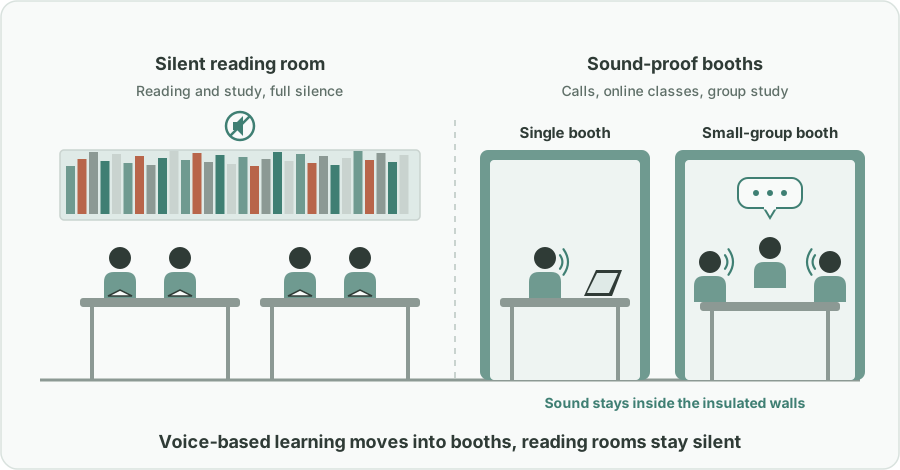
Create sound-insulated booths inside libraries, sized for individual use or for a small group, so that voice-based activities have their own place:
- Only where capacity allows: booths are added where the reading area has spare capacity, so seats for silent reading are not sacrificed. Libraries first look at how their reading space is actually used.
- Two sizes: single booths for calls, online classes and language practice, and small-group booths for study groups and short meetings.
- Clear rules: speaking is allowed only inside booths. Reading rooms stay fully silent, and signs make the difference obvious.
- Fair access: booths can be booked for a limited time slot, with walk-in use when free, so a few users cannot occupy them all day.
- Basic comfort: a desk, a seat, power, good lighting and ventilation, so a booth is a real place to learn and not a cupboard.
How It Works
| User need | Where it happens |
|---|---|
| Silent reading and study | Reading rooms, as today |
| Language practice, listening to lectures out loud | Single booth |
| Online class, exam or video meeting | Single booth |
| Short phone call | Single booth, or a short walk-in slot |
| Study group or small team discussion | Small-group booth |
flowchart TD
    Arrive(["User arrives at the library"]) --> Need{"Needs to speak or listen out loud?"}
    Need -->|No| Read["Reading room: full silence"]
    Need -->|Yes| Free{"Booth free now?"}
    Free -->|Yes| Use["Use the booth for a limited slot"]
    Free -->|No| Book["Book the next free slot"]
    Book --> Use
    Use --> Done["Slot ends, booth is freed for the next user"]
Implementation & Phasing
- Usage review: libraries review how their reading space is used and where there is spare capacity.
- Pilot: a few large libraries install a small number of booths and track demand, booking patterns and user feedback, including feedback from silent readers.
- Rollout: booth numbers and sizes are adjusted to the pilot results and extended to other libraries where capacity allows.
- Standard design: new library buildings and major renovations plan booth space from the start.
Stakeholders & Benefits
- Students and lifelong learners: a free public place for voice-based learning, online classes and exams.
- Silent readers: fewer whispers and phone conversations in reading rooms.
- Remote workers and job seekers: a quiet, private place for interviews and meetings.
- Libraries: better use of existing space, more visitors and a modern role in the community.
- Local and national governments: support for digital learning using buildings they already own.
Risks & Mitigations
| Risk | Mitigation |
|---|---|
| Booths reduce seats for silent reading | Booths only where reading capacity allows; usage review before installation |
| Sound still leaks into reading rooms | Proper sound insulation and placement away from the quietest areas |
| A few users occupy booths all day | Time-limited slots and a simple booking system |
| Booths used for purposes unrelated to learning or work | Clear usage rules and staff oversight |
| Installation and upkeep cost | Pilot first, then rollout sized to measured demand |
Keywords: public libraries, sound-proof booths, quiet study, voice-based learning, online classes, remote work, language learning, lifelong learning, library design
Support This Work
If you find this idea useful, you can support the author’s open work through GitHub Sponsors.
Origin
Originally proposed by Merih İlgör (June 2025); published here as an open project idea.
License
This work is licensed under CC BY-NC-SA 4.0 for non-commercial use; see LICENSE. Commercial use requires a revenue-share agreement; see COMMERCIAL-LICENSE.md. Modified versions may not be sold or transferred to third parties as new ideas, and patent-like rights are reserved; see COMMERCIAL-LICENSE.md.