Open Projects
Türkçe: README.tr.md
Smart Relay Panel for Fire Prevention: Switching Off Whole Circuits When Nobody Needs Them
Summary
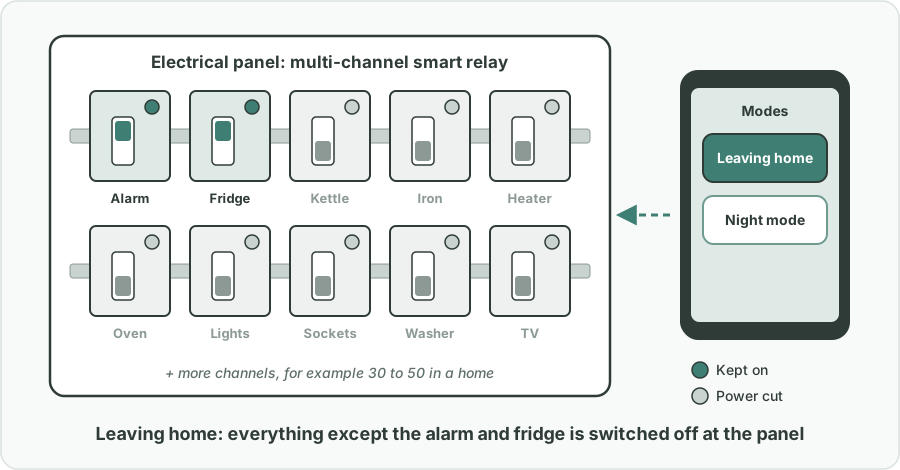
A kettle left on, an iron that was not unplugged, a heater running in an empty room: forgotten appliances and electrical leakage are a well-known cause of fires in homes and workplaces. Today’s answer is usually a smart plug for each socket, which is fiddly, expensive to scale and easy to skip. This proposal moves the control to where all the circuits already meet: a multi-channel smart relay mounted in the electrical panel (a home might need roughly 30 to 50 channels). With one command, or on a schedule, it can cut power to everything except the alarm and the fridge when people leave home, and switch off unused circuits at night. Because it lowers fire claims, insurers have a direct reason to sponsor it, for example as a gift in home insurance campaigns. Adoption starts in factories, then spreads gradually to homes, backed by standards, incentives and, in time, a requirement.
Problem
- Many fires start from appliances that were forgotten or left on: kettles, irons, electric heaters, cookers and similar devices, or from electrical leakage in circuits that stay powered all the time.
- When people leave home or go to sleep, almost every circuit stays live, even though only a few (such as the alarm and the fridge) actually need power.
- Smart plugs protect one socket at a time. Covering a whole home means many separate devices, each to buy, install, set up and maintain. Lights, built-in appliances and wired devices are often not covered at all.
- The people who pay most for electrical fires (households, businesses and their insurers) have no simple, whole-building tool for reducing the risk every day.
Proposed Solution
Put circuit-level control into the electrical panel, and let insurers help pay for it:
- Panel-mounted, multi-channel smart relay: a rail-mounted unit in the electrical panel with many channels (for example 30 to 50 for a home, more for a factory), so each circuit or group of circuits can be switched on or off without touching individual sockets or appliances.
- Simple modes that match daily life:
- Away mode: when the last person leaves, power is cut to everything except essential circuits such as the alarm and the fridge.
- Night mode: circuits that are not used at night (for example the kitchen, the ironing corner, the office) are switched off.
- Schedules: circuits that are only needed at certain times are powered only then.
- Essential circuits are protected: circuits marked as essential (alarm, fridge, medical devices, heating safety) can never be switched off by a mode.
- Manual control always works: people can switch any non-essential circuit back on at once, from the home or remotely.
- Insurer sponsorship: insurers offer the system as a gift or discount in home and business insurance campaigns, because fewer fires means fewer claims.
How It Works
| Situation | What happens |
|---|---|
| Everyone leaves home and away mode is activated | Only essential circuits (alarm, fridge) stay on. Kettle, iron, heater, oven, sockets and lights are switched off. |
| Night | Circuits marked as unused at night are switched off; bedrooms and essentials stay on. |
| Someone comes home | Normal power is restored to all circuits. |
| A person needs a circuit during a mode | They switch that circuit back on with one action. |
| The relay unit itself has a fault | It falls back to normal power and signals the fault, so the home is never left without essentials. |
flowchart TD
    Trigger(["Leaving home, bedtime or schedule"]) --> Mode{"Which mode?"}
    Mode -->|Away| Away["Cut all circuits except essentials"]
    Mode -->|Night| Night["Cut circuits not used at night"]
    Mode -->|Schedule| Sched["Power circuits only when needed"]
    Away --> Ess["Essential circuits always on: alarm, fridge"]
    Night --> Ess
    Sched --> Ess
    Away --> Back{"Someone returns or needs a circuit?"}
    Night --> Back
    Back -->|Yes| Restore["Power restored with one action"]
    Fault["Relay unit fault"] --> Safe["Fall back to normal power and signal the fault"]
People do not need to remember every appliance. They only need to leave home or go to bed, and the panel takes care of the rest.
Implementation & Phasing
- Factories and workplaces first: start where circuits, shifts and fire risks are well understood and insurance values are high. Factories switch off whole areas outside working hours.
- Insurer-sponsored homes: insurers include the panel relay in home insurance campaigns, as a gift or discount, and electricians install it in existing panels.
- Standards: the building and electrical regulators define a standard for panel-mounted smart relays, including essential-circuit protection, fail-safe behavior and installation by qualified electricians.
- Incentives: lower insurance premiums and public incentives for buildings that install the system.
- Gradual requirement: once the standard is proven, the system becomes a requirement, first in new buildings and major renovations, then more widely.
Stakeholders & Benefits
- Households and workers: fewer fires and fewer deaths and injuries from fires, with no need to remember every appliance.
- Businesses and factories: protection of premises, stock and jobs, and lower standby energy use outside working hours.
- Insurers: fewer and smaller fire claims, which pays for sponsoring the system.
- Electricians and manufacturers: a new product category and steady installation work.
- Fire services and emergency management: fewer call-outs for preventable fires.
- Building and electrical regulators: a clear, testable safety measure that can be introduced step by step.
Risks & Mitigations
| Risk | Mitigation |
|---|---|
| An essential device (fridge, alarm, medical equipment) loses power | Essential circuits are marked at installation and can never be switched off by a mode |
| The relay unit fails or loses its connection | Fail-safe design: on a fault it returns to normal power and signals the problem |
| Unsafe installation | Installation only by qualified electricians, following the published standard |
| Cost for households | Insurer sponsorship, premium discounts and public incentives |
| People find it confusing | A few simple modes (away, night, schedule) and a one-action override |
Keywords: fire prevention, electrical safety, smart relay, electrical panel, home automation, insurance, forgotten appliances, building safety, energy saving, risk reduction
Support This Work
If you find this idea useful, you can support the author’s open work through GitHub Sponsors.
Origin
Originally proposed by Merih İlgör (December 2025); published here as an open project idea.
License
This work is licensed under CC BY-NC-SA 4.0 for non-commercial use; see LICENSE. Commercial use requires a revenue-share agreement; see COMMERCIAL-LICENSE.md. Modified versions may not be sold or transferred to third parties as new ideas, and patent-like rights are reserved; see COMMERCIAL-LICENSE.md.