Open Projects
Türkçe: README.tr.md
AKASU: Solar-Powered Smart Water Refill Stations and Integrated Plastic Waste Reduction
Nationwide solar-powered smart drinking-water refill stations, packaging standardization and integrated plastic waste reduction project for Türkiye (AKASU).
Summary
Single-use thin PET water bottles and shopping bags are the most common sources of litter on Türkiye’s coastlines, in national parks and in busy city centres. AKASU proposes to cut this waste at the source by combining:
- a network of solar-powered, remotely monitored smart water refill stations installed at high-traffic “Points of Interest” (public beaches, squares, parks), built and run by bottled-water companies in proportion to their market share;
- a self-sustaining, win-win business model in which water companies sell water through stations instead of bottles, so the stations become a profitable new sales channel rather than a municipal cost item;
- public-health and hygiene controls (automatic cleaning and water treatment to Ministry of Health standards, real-time water-quality reporting to the Ministry, mandatory inspections);
- a revision of packaging standards (following the UK model) that replaces thin, small PET bottles with larger, thick, reusable bottles that work as personal flasks;
- pricing and tax measures that make refilling significantly cheaper than buying bottled water and keep environmental charges on bags and single-use bottles indexed to inflation.
The expected result: no additional financial or waste-collection burden on the state or local governments, a sharp drop in marine microplastic load, and a shift from a “use-and-throw” culture to a smart, economical, solar-powered “refill” ecosystem.
Problem
- PET bottle pollution. Thin single-use PET bottles are very cheap to produce. This feeds a “use-and-throw” culture: bottles are left in nature after use and cause lasting pollution. Single-use water bottles are among the largest waste items collected on coastlines, picnic areas and city centres, especially in summer, followed by plastic bags and cigarette butts.
- Plastic bag consumption. The fixed 25 kuruş charge for supermarket bags has lost its deterrent effect against inflation. Bag use, and bag waste in nature, has risen again. Bags are seen alongside PET bottles as litter on beaches, often outside the bins.
- Why earlier approaches stall. Many environmental projects stay on paper, or are blocked by lobbying, because they clash with the economic interests of the private sector. Free or subsidized public fountains also tend to become neglected and fall out of use (the “idle public fountain syndrome”).
Proposed Solution
AKASU aims to minimize plastic waste and the carbon footprint at the source through smart, connected infrastructure, 100% renewable energy, new packaging standards and a business model that serves the economic interests of all stakeholders (the public sector, the private sector and citizens). It does not rely on a simple ban. It builds a circular-economy system that puts responsibility directly on the producers (the water companies) and gives them an economic incentive.
The solution has six components:
| # | Component | Core idea |
|---|---|---|
| A | Smart refill station network | Mandatory stations at Points of Interest, installed by water companies in proportion to market share. They never run dry, alert the company automatically when they need refilling, take contactless payment and offer several fill volumes. |
| B | Climate control and renewable energy | Water kept at the ideal drinking temperature in every season with minimal energy. Solar power runs every station function off-grid. |
| C | Sustainable business model (win-win) | Water companies, not municipalities, install, operate and maintain the stations and sell water through them as a new sales channel. |
| D | Public health and hygiene | Automatic cleaning and water treatment, real-time water-quality reporting, mandatory periodic inspections. |
| E | Packaging standards (UK model) | Restrict thin, small PET bottles. Require larger, thick, reusable bottles that become personal flasks. |
| F | Pricing and consumer behaviour | Refilling is much cheaper per litre than shelf water. Environmental taxes on bags and single-use bottled water are indexed to the revaluation rate. |
How It Works
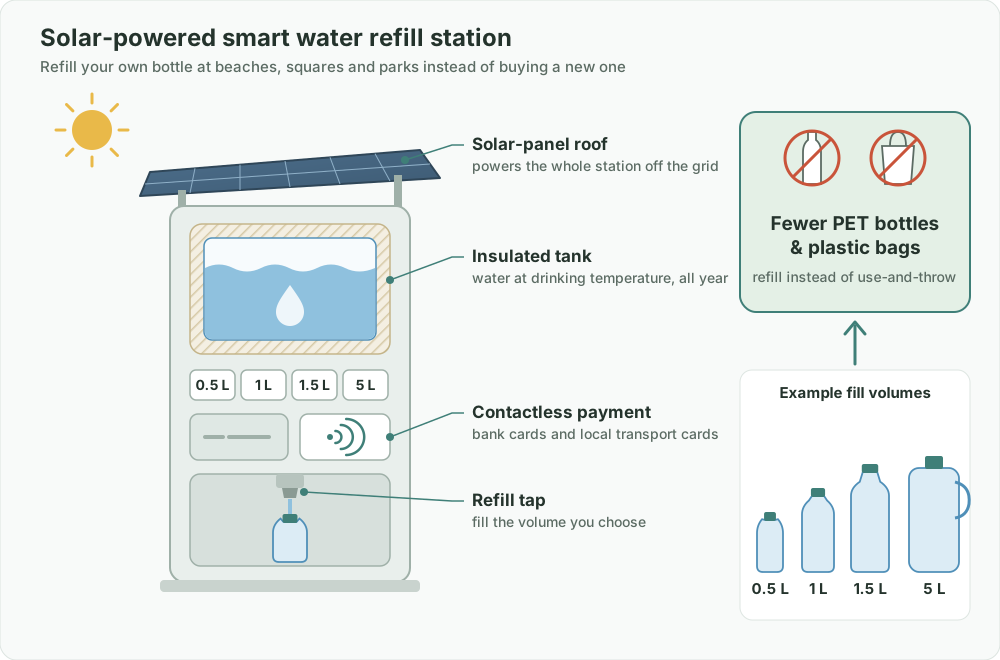
A. Smart refill station network
- Siting and obligation. “Points of Interest” (public beaches, squares, parks and similar locations) are identified based on population density and tourist capacity. At each one, a number of stations suited to its human capacity becomes mandatory under the Ministry of Environment, Urbanization and Climate Change. The total number of stations needed is set as a mandatory target for the large water companies. Each company receives a quota for installing and operating stations in proportion to its market share.
- Uninterrupted service. Each station holds a reserve supply. When the main supply runs out, the station keeps serving from the reserve and automatically sends a “refill request” to the water company, which refills it. This keeps stations from going idle.
- Contactless payment. Users can pay contactlessly, including with bank cards and local transport cards (for example, İstanbulkart).
- Flexible fill volumes. Stations offer several volumes to suit users’ needs, such as 0.5 L, 1 L, 1.5 L and 5 L.
B. Climate control, energy efficiency and renewable energy
- Protection from summer heat. Stations are well insulated, so the water is not affected by high summer temperatures and little energy is needed for cooling.
- Ideal drinking temperature. The water is kept at the ideal drinking temperature in every season: chilled in hot weather and protected against freezing in extreme cold, so stations can sell chilled water.
- Solar power. Solar panels on the stations supply all the energy they need (payment, monitoring, water treatment, cooling and heating), independently of the grid. This brings the project’s carbon footprint to zero.
C. Sustainable business model and private-sector integration (win-win)
- For the project to succeed and last, water-producing companies, not municipalities, are responsible for installing, operating and maintaining the stations.
- If municipalities provided this service as “free or subsidized public fountains”, it would compete directly with the water companies’ existing business, provoke justified resistance from the private sector, and leave municipalities with a maintenance cost (expense item) they could not sustain.
- Instead, water companies sell water directly through stations rather than in bottles. This does not threaten their business model. It only changes the distribution channel. Freed from packaging, logistics and storage costs, the companies gain stations that work as profitable, next-generation points of sale. The project therefore finances itself.
- Companies earn commercial revenue from the system and display their own brand identity (logos) on the stations. This gives them a natural incentive to keep stations clean, maintained, hygienic and working, which prevents the idle public fountain syndrome.
D. Public health and hygiene controls
- Stations clean themselves automatically and treat the water to Ministry of Health standards.
- Water quality is reported in real time to the Ministry of Health (and to local governments).
- Periodic hygiene and microbiological inspections are mandatory.
E. Revision of packaging standards (UK model)
- Production of “thin and small” (330 ml, 500 ml) PET bottles, which push consumers to buy and throw away frequently, is restricted.
- Following the UK and similar countries, standard small bottle sizes are increased (for example, a standard 750 ml or 1 L). These bottles must be made from thick materials that withstand repeated use and do not leach harmful substances.
- The bottle stops being “rubbish” and becomes a personal flask that can be refilled at the stations.
- The same approach applies to 5 L water: durable, refillable 5 L formats are encouraged.
F. Pricing and consumer behaviour change
- The per-litre cost of filling from a station is significantly lower than that of packaged water on the shelves.
- Environmental taxes on single-use packaged water raise shelf prices, so the price gap gives consumers a strong economic reason to refill instead of buying a new bottle and discarding it.
- Environmental taxes and fees on supermarket bags and single-use packaged water are indexed to the “Revaluation Rate” (or an inflation index) and update automatically every year. This keeps them a deterrent and stops the erosion seen with the fixed 25 kuruş bag charge.
Implementation & Phasing
The source sets out the project as a set of parallel workstreams rather than a dated timeline. The steps follow from the design above:
- Identify Points of Interest and capacity. Map beaches, squares, parks and other high-traffic locations by population density and tourist capacity. Set the required number of stations per location.
- Allocate quotas. Set the national station requirement as a mandatory target for large water companies and assign it in proportion to market share.
- Deploy stations. Water companies install solar-powered smart stations with contactless payment and several fill volumes. They also take on operation, refilling and maintenance.
- Hygiene regime. Connect stations to Ministry of Health (and local government) reporting systems and start mandatory periodic hygiene and microbiological inspections.
- Packaging regulation. Restrict thin, small PET bottles and require larger, thick, reusable bottles, including durable refillable 5 L formats.
- Pricing and tax indexing. Keep station water much cheaper than shelf water, apply environmental taxes to single-use bottled water, and index bag and packaging charges to the revaluation rate with automatic annual updates.
Stakeholders & Benefits
| Stakeholder | Role | Benefit |
|---|---|---|
| Ministry of Environment, Urbanization and Climate Change | Sets mandatory station requirements per Point of Interest, allocates market-share quotas, regulates packaging standards and environmental charges | Less plastic litter and marine microplastic, zero-carbon service, no additional public spending |
| Ministry of Health | Sets hygiene standards, receives real-time water-quality data, requires periodic inspections | Protection of public health at refill points |
| Bottled-water companies | Install, operate, refill and maintain stations. Display their brand | A profitable new sales channel. Savings on packaging, logistics and storage. The business model is transformed, not threatened |
| Municipalities / local governments | Host stations at Points of Interest. Receive quality reports | No station maintenance cost. Lower waste-collection costs |
| Citizens and tourists | Refill personal bottles with contactless payment in several volumes | Cheaper, hygienic water at the ideal drinking temperature. Durable personal flasks |
| Environment | Sharp reduction in marine microplastic load. A lasting refill culture replaces use-and-throw |
Expected outcomes
- No additional financial burden or waste-collection cost for the state or local governments. Local governments’ waste-collection costs fall.
- The private sector keeps doing business, now in an environmentally friendly way.
- The microplastic load in the marine ecosystem drops sharply.
- Solar power delivers the service with zero carbon emissions.
- A reliable, renewable-powered, hygienic, smart and economical “refill” ecosystem replaces the “use-and-throw” culture and becomes lasting consumer behaviour.
Risks & Mitigations
| Risk | Mitigation (from the proposal) |
|---|---|
| Stations run dry or fall idle | A reserve supply keeps the station serving. Automatic refill requests go to the water company. Companies earn from working stations, so they have a reason to keep them running |
| Private-sector resistance and lobbying against the project | Stations are a profitable sales channel for water companies rather than free public fountains that compete with them. Only the distribution channel changes |
| Municipal maintenance burden and the idle public fountain syndrome | Water companies, not municipalities, handle installation, operation and maintenance. Branding and revenue motivate upkeep |
| Hygiene and public-health concerns | Automatic cleaning and water treatment, real-time reporting to the Ministry of Health, mandatory microbiological inspections |
| High summer temperatures and energy use | Well-insulated, low-energy temperature control, powered by solar |
| Environmental charges losing effect to inflation (as with the 25 kuruş bag fee) | Automatic annual indexing to the revaluation rate |
| Consumers keep buying single-use bottles | A large price gap between station water and shelf water. Thin, small PET bottles restricted. Durable bottles that work as personal flasks |
References / Examples
- United Kingdom model: larger standard bottle sizes made from thick materials that can be reused many times, cited as the reference for the packaging standards revision.
- Türkiye’s 25 kuruş supermarket bag charge: cited as a fee that lost its deterrent effect against inflation.
- İstanbulkart: cited as an example of a local transport card usable for contactless payment at stations.
Keywords: plastic waste reduction, PET bottles, water refill stations, solar energy, circular economy, zero waste, plastic bag fee, sustainability, municipal services, public health
Support This Work
If you find this idea useful, you can support the author’s open work through GitHub Sponsors.
Origin
Originally drafted by Merih İlgör as a public policy proposal (August 2026); published here as an open project idea.
License
This work is licensed under CC BY-NC-SA 4.0 for non-commercial use; see LICENSE. Commercial use requires a revenue-share agreement; see COMMERCIAL-LICENSE.md. Modified versions may not be sold or transferred to third parties as new ideas, and patent-like rights are reserved; see COMMERCIAL-LICENSE.md.