Open Projects
Türkçe: README.tr.md
Global Salary Payment Balance (GSPB): Staggered Salary Payment Days
Summary
The Global Salary Payment Balance (GSPB) model proposes splitting the working population worldwide, in both public and private sectors, into four equal groups, each paid on a different day of the month: the 7th, 14th, 21st or 28th. When payday is spread across the month, spending, billing, dunning (reminders for overdue payments), logistics traffic and data-center processing load are also spread out. The result is lower energy use and carbon emissions, a steadier commercial cycle, and more reliable digital payment systems.
Problem
In both the private and public sectors worldwide, employees are usually paid on the same fixed day of the month, typically in the first half (often between the 1st and the 15th). Consumer behaviour follows that date:
- Many billing systems already run four bill cycles. Even so, credit card holders set their statement dates to fall just after payday, and people without credit cards time their purchases for the days right after they are paid.
- As a result, demand, billing and payment activity pile up on the same few days of the month.
This concentration causes several connected problems.
Congestion and energy use in logistics networks
- Consumer spending jumps right after payday, especially in e-commerce and retail. That causes sudden spikes in logistics (cargo and delivery) traffic.
- The spikes mean more fossil-fuel vehicle use, more traffic congestion and more operational inefficiency. Energy consumption and carbon emissions rise as a direct result.
Overload in digital payment and billing systems
- Billing systems, and the dunning processes that follow up on overdue payments, see load spikes because transaction volume piles up on certain days of the month.
- In data centers, these spikes cause performance problems. Server resources are also scaled up to meet the sudden demand, which uses excessive energy.
- The extra energy use creates extra cooling demand, which increases the carbon footprint of data centers further.
Economic imbalance
- When consumer spending piles up on a few days of the month, the commercial cycle becomes stop-start. That makes commercial forecasting and inventory management harder.
This is a predictable environmental burden, and it works against global zero-carbon targets.
Proposed Solution
The proposal is to move, worldwide and across both public and private employers, to a balanced salary calendar. The working population is split into four equal groups (quarters), and each group is paid in a different week of the month:
| Group | Share of working population | Salary payment day |
|---|---|---|
| Group 1 | 25% | 7th day of the month |
| Group 2 | 25% | 14th day of the month |
| Group 3 | 25% | 21st day of the month |
| Group 4 | 25% | 28th day of the month |
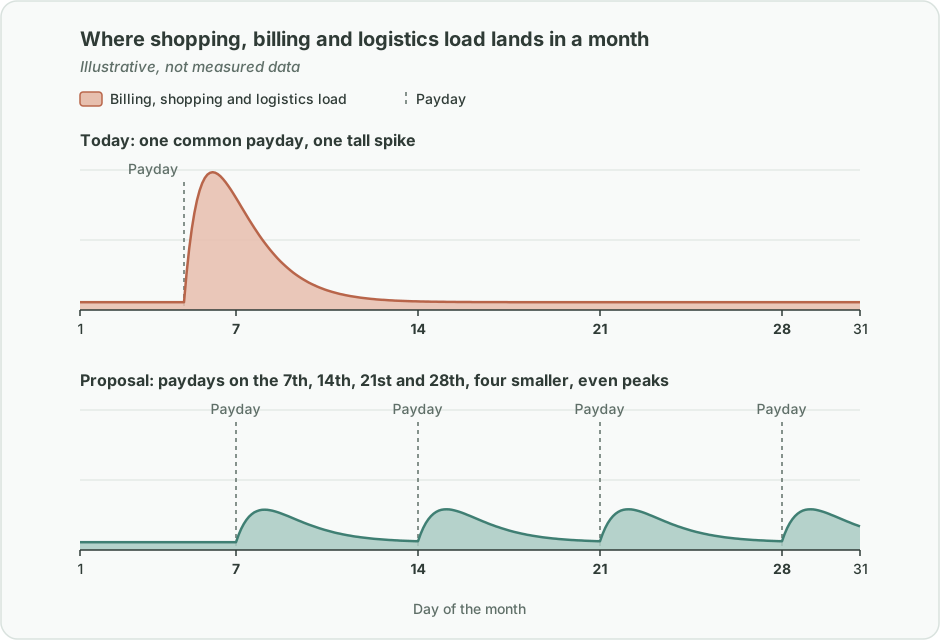
This spreads the load on trade and on online systems evenly across the month, dunning activity included. The result is a greener and economically more balanced ecosystem.
How It Works
- Grouping: The entire working population is divided into four equal groups (25% / 25% / 25% / 25%), balanced across public and private employers.
- Payment calendar: Each group receives its salary on a fixed day: the 7th, 14th, 21st or 28th.
- Consumer spending follows payday: Purchases cluster right after payday. With four staggered paydays, consumer spending and the logistics traffic it generates are spread over four peaks of similar size instead of one large peak.
- Billing cycles line up with the groups: Credit card holders tend to choose a statement date just after payday. They would then fall naturally into four different statement dates, which spreads the load across billing systems’ existing four bill cycles.
- Dunning is balanced too: Billing is followed by collection and, for overdue accounts, by dunning. Both are spread across four dates instead of piling up on one.
- Even infrastructure load: Processing load on online payment, billing and banking systems becomes more even. Data centers need less sudden scaling, so they use less excess energy and cooling.
Implementation & Phasing
- Review: The model would be reviewed under the leadership of the World Economic Forum (WEF), together with national governments and major global organizations.
- Pilot programmes: Pilots would be run with governments, central banks and major private-sector players, starting with the G20 countries.
- Global adoption: Based on the pilot results, the model would be extended to employers worldwide.
Stakeholders & Benefits
Implementing stakeholders and partners (as identified in the source):
- The World Economic Forum (WEF), as the proposed lead
- National governments, starting with the G20 countries
- Central banks
- Major private-sector players and global organizations
- Organizations that set and track zero-carbon and sustainability targets, such as the United Nations and the World Business Council for Sustainable Development (WBCSD)
Expected benefits:
| Category | Benefits |
|---|---|
| Environmental sustainability | Balancing traffic and congestion in logistics networks cuts transport fuel use and carbon emissions. Evening out data-center processing load avoids sudden scaling and excessive energy and cooling use, which significantly reduces data centers’ carbon footprint. |
| Economic balance | Consumer spending and commercial activity are spread across the month, which makes the commercial cycle more stable. Billing, collection and dunning activity are spread across four dates, which makes financial operations more efficient. Inventory management also becomes more efficient. |
| Financial efficiency | Credit card users can spread statement dates that fall just after payday across four options, which improves financial planning. |
| System performance | Load on online payment, billing and banking systems is spread evenly instead of piling up on certain days of the month. This improves performance and reliability and lowers the risk of service interruptions. |
GSPB is more than a financial adjustment. It is a simple, practical mechanism that helps meet global zero-carbon targets through logistics and digital infrastructure. It links economic growth with environmental responsibility, and it supports both economic stability and environmental sustainability.
Keywords: payroll, salary payment dates, peak load, billing cycles, logistics, data center energy, carbon emissions, economic policy, sustainability
Support This Work
If you find this idea useful, you can support the author’s open work through GitHub Sponsors.
Origin
Originally drafted by Merih İlgör as a public policy proposal (December 2025); published here as an open project idea.
License
This work is licensed under CC BY-NC-SA 4.0 for non-commercial use; see LICENSE. Commercial use requires a revenue-share agreement; see COMMERCIAL-LICENSE.md. Modified versions may not be sold or transferred to third parties as new ideas, and patent-like rights are reserved; see COMMERCIAL-LICENSE.md.