Open Projects
Türkçe: README.tr.md
Zero Tax Until First Profit: Encouraging New Businesses with a Simple Startup Tax Status
Summary
Starting a business is risky, and the first years rarely bring a profit. This proposal gives every newly founded business, including sole proprietorships, a simple startup tax status: as long as the new business has made no profit, it pays zero income or corporate tax. After its first profitable year, the business moves to normal tax rates through a short, graduated transition that is easy to follow. Setting up a business is made simple and low-cost, and a digital startup tax status card shows founders at a glance which rights they have and what they owe. The goal is to give people the courage to start new businesses and to bring informal activity into the formal economy.
Problem
- Many good business ideas never start because founders fear that costs, paperwork and tax obligations will arrive before any income does.
- Tax rules for new businesses are often complex and hard to predict. Founders cannot easily tell what they will owe, when, and why.
- Because being formal feels expensive and complicated, some people work informally instead: they do not register a business, do not appear in official records, and cannot grow, hire openly or access formal finance.
- A new business that has not yet made a profit is still building its product, customers and team. Any tax or fixed charge in this period drains the cash it needs to survive.
- When a business finally becomes profitable, a sudden jump to full tax rates can be a shock that discourages growth.
Proposed Solution
A startup tax status that is generous while a business is unprofitable, predictable afterwards, and simple from day one:
- Who qualifies: every newly founded business, whatever its legal form: companies of all kinds and sole proprietorships. There is no need to be a technology company or to win a special program.
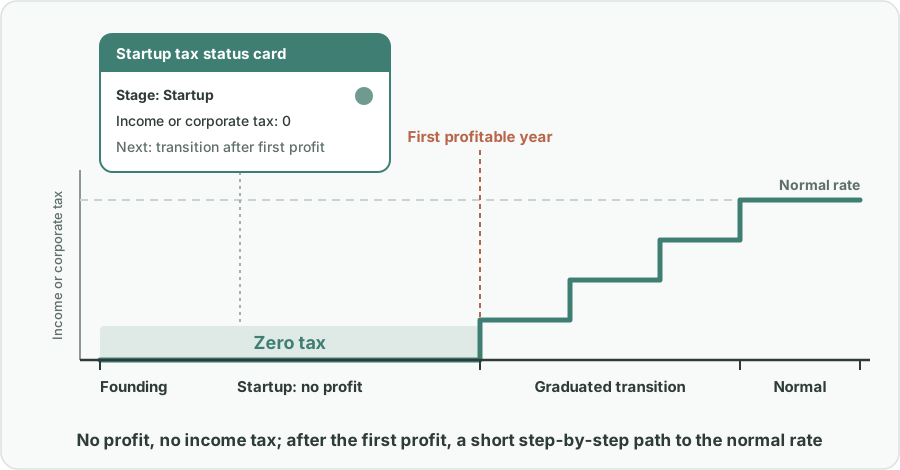
- Zero tax until first profit: from founding until its first profitable year, within a defined startup period, a business that has made no profit pays zero income or corporate tax. (The original proposal suggested covering the founding year and the following year as a starting point.) Ordinary obligations that do not depend on profit, such as collecting sales taxes from customers and social security for employees, continue as normal.
- Graduated transition after the first profit: after the first profitable year, the tax rate rises step by step to the normal rate over a short, fixed schedule, in line with the business’s growth, so the business can prepare for the increase instead of facing a sudden jump.
- Simple and transparent rules: the status, its duration and the transition steps are written into the rules in plain terms, with no complex calculations. A founder should be able to understand them in minutes.
- Digital startup tax status card: each business can see, online, a simple card that shows its current stage (startup, transition or normal), what it owes, what it does not owe, and when the next stage begins.
- Low-cost, simple setup: founding a business, including a sole proprietorship, is made quick, simple and low-cost, preferably in a single online process, so the startup status is not cancelled out by setup fees and paperwork.
Some countries already run small-company and startup-friendly schemes, such as those in the United Kingdom, that show public policy can actively lower the barriers to starting a business. This proposal takes that general spirit and focuses on one clear, easy-to-explain rule: no profit, no income tax.
How It Works
| Stage | When | What the business pays in income or corporate tax |
|---|---|---|
| Setup | Day of founding | Quick, simple, low-cost registration; the startup tax status card is issued |
| Startup | From founding until the first profitable year | Zero |
| Transition | The years after the first profitable year | A reduced rate that rises step by step on a fixed, published schedule |
| Normal | After the transition | The normal rate that applies to all businesses |
flowchart LR
    Found(["New business founded, including sole proprietorships"]) --> Card["Startup tax status card issued"]
    Card --> Startup["Startup stage: zero income or corporate tax"]
    Startup --> Profit{"First profitable year?"}
    Profit -->|No| Startup
    Profit -->|Yes| Transition["Graduated transition: rate rises step by step"]
    Transition --> Normal["Normal tax rate"]
    Card -.->|"Always shows the current stage, rights and obligations"| Founder["Founder"]
Implementation & Phasing
- Design: the tax authority defines the startup status, its maximum duration, the transition schedule and simple anti-abuse rules, and publishes them in plain language.
- Simple setup: a single, low-cost online process for founding a business, including sole proprietorships, is put in place or improved.
- Status card launch: every new business receives a digital startup tax status card at founding.
- Monitoring: the number of new businesses, how many move from informal to formal activity, survival rates and the tax collected after the transition are tracked and published.
- Adjustment: the duration and the transition steps are adjusted based on the results.
Stakeholders & Benefits
- Founders and would-be founders: the courage to start, because an unprofitable business does not owe income tax; clear rules and a card that shows exactly where they stand.
- Sole proprietors and small traders: a simple, low-cost way to become formal without fear of immediate tax costs.
- Employees: more new businesses means more jobs, and formal businesses offer formal, protected employment.
- The tax authority and the public budget: a wider tax base over time, as businesses that would never have started, or would have stayed informal, become formal and later profitable taxpayers.
- The wider economy: more innovation, competition and value added.
Risks & Mitigations
| Risk | Mitigation |
|---|---|
| Existing businesses close and reopen to restart the startup status | The status applies only to genuinely new activity; simple rules link a new business to earlier businesses of the same owners |
| Profits are hidden or shifted to stay in the startup stage | The startup stage has a maximum duration; normal reporting and audits still apply |
| Short-term loss of tax revenue | The zero rate covers only businesses that have not yet made a profit, so the direct cost is limited; more formal businesses widen the tax base over time |
| Rules become complicated again over time | A commitment to plain-language rules and a single status card that must stay understandable |
| Founders misunderstand what they still owe | The status card clearly lists what is and is not covered, such as sales taxes and employee social security |
Keywords: startup tax, entrepreneurship, small business, sole proprietorship, corporate tax, income tax, graduated tax, informal economy, business formation, tax simplification
Support This Work
If you find this idea useful, you can support the author’s open work through GitHub Sponsors.
Origin
Originally proposed by Merih İlgör (June 2025); published here as an open project idea.
License
This work is licensed under CC BY-NC-SA 4.0 for non-commercial use; see LICENSE. Commercial use requires a revenue-share agreement; see COMMERCIAL-LICENSE.md. Modified versions may not be sold or transferred to third parties as new ideas, and patent-like rights are reserved; see COMMERCIAL-LICENSE.md.