Open Projects
Türkçe: README.tr.md
Secure Contract Flow: Pre-Reviewed, Version-Locked Contracts and a Real “Read and Understood” Check
Summary
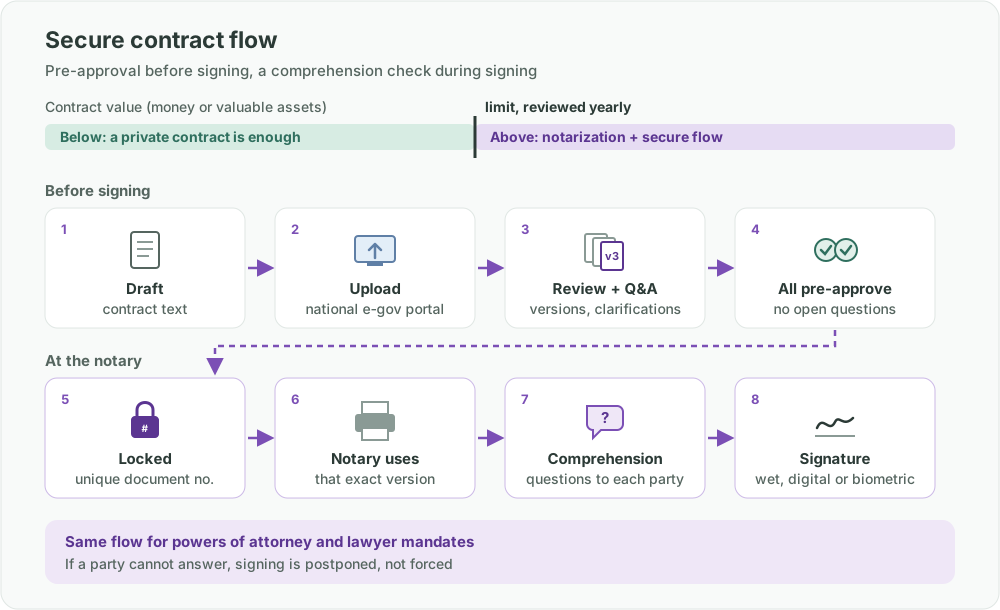
High-value and complex contracts are often signed under pressure, without being read, and sometimes on a different copy from the one the parties reviewed. This proposal introduces a secure contract flow:
- A value threshold. Private contracts about money or valuable assets above a yearly-reviewed limit are valid only when notarized.
- Online pre-review. Before signing, the contract goes through a pre-review stage on the national e-government portal. Every party can read it at their own pace, propose new versions and approve the final text.
- Questions and clarifications. During review, any party can ask about an unclear clause or term. Each answer either changes the text, becomes a binding clarification locked with the contract, or is kept for information. A version cannot be locked while questions are open.
- A version lock. The approved version is locked under a unique document number, and the notary prints exactly that version.
- A real comprehension check. At signing, the notary asks each party questions about the key terms, so “I have read and understood” becomes something actually verified.
- Flexible signing. Depending on what is available, the parties sign with a wet signature on paper, or with a digital or biometric signature on the digital document. The version lock and comprehension check apply the same way.
- The whole contract lifecycle. The unique document number stays the contract’s anchor after signing: attachments, amendments, sub-contracts, renewals, expiration, cancellation, termination and completion are all recorded against it, so the current status and full history of a contract are always clear.
In short: pre-approval before signing, and a comprehension check during signing.
Problem
- High-value private contracts have no safeguard. Contracts involving large sums of money or valuable assets can be made privately, with no independent check of what the parties agreed to.
- People sign what they have not read. Contracts can run to dozens of pages and use dense, ambiguous language. At the notary, people often write “I have read and understood” and sign a contract they never actually read.
- The copy you read may not be the copy you sign. When drafts are exchanged informally, a party can review one version and sign another, intentionally altered or not.
- Unclear terms are settled only after signing. A vague clause, such as “delivery within 30 days” (working or calendar days?), is either never asked about or explained orally before signing, and the explanation is lost. The question comes back later as a dispute.
- “Are you of sound mind?” is answered in a second. Someone who has just had an accident, a bereavement or another severe shock may say “yes”, yet be unable to read, grasp and judge a contract on the spot.
- Powers of attorney carry the same risk. People grant powers without knowing exactly what they authorize, and the same gap appears again in the mandate given to a lawyer afterwards.
Proposed Solution
- Value threshold for private contracts. Contracts about money or valuable assets get a legal ceiling for private agreements, set nationally and reviewed every year in line with inflation and social conditions (for example, around 500,000 Turkish lira at today’s values). Above the ceiling, a contract is not legally valid without notarization.
- Online pre-review stage. For contracts above the threshold, and for critical, long or semantically complex contracts, the draft is submitted to the national e-government portal or a similar central state system. Every party can download, read and examine it in detail, with enough time.
- Versioning between the parties. The parties can propose new versions or edits through the system until they agree. Every version is kept with its history, so it is always clear who changed what.
- Questions and clarifications. During review, any party can ask a question tied to a specific clause or term. The answer either changes the text (a new version), becomes a binding clarification that all parties accept and that is locked with the contract, or is recorded for information. A version cannot be locked while a question is open (see Questions and Clarifications).
- Mutual pre-approval and a unique document number. When all parties approve the final version online, the system locks it and assigns a unique document number.
- The notary uses exactly that version. Using the document number, the notary prints the locked contract or opens it as a digital document. Reading one copy and signing another becomes impossible.
- Comprehension check at signing. The notary asks each party questions about the key terms and possible consequences of the contract they already reviewed. “I have read and understood” becomes an actual check, not a formality.
- A practical answer to “sound mind”. A person who had time to study the contract beforehand and can answer questions about it shows real understanding. That gives the notary a well-grounded judgment about their capacity. Someone in acute shock who cannot answer has signing postponed, not forced.
- The same flow for powers of attorney and lawyer mandates. The person granting a power of attorney reviews exactly what they authorize beforehand and answers comprehension questions at signing. A similar step applies when that power is passed on to a lawyer.
- Signature method that fits the available means. The signature can be a wet signature on paper, or a digital or biometric signature on the digital document, depending on what the notary and the parties can use. Whatever the method, the signature is applied only to the locked version and only after the comprehension check.
- Managing the contract over its whole life. Signing is not the end of the flow. Every later event, such as an amendment, a sub-contract, an extension, a cancellation or a termination, is recorded against the same unique document number. Changes that alter the parties’ rights or obligations go through the same pre-review, approval, lock and comprehension check; simple status events are recorded with lighter steps (see Contract Lifecycle).
How It Works
| Situation | Today | With the secure contract flow |
|---|---|---|
| A long, complex contract | Read in minutes at the notary, or not at all | Reviewed beforehand, at each party’s own pace |
| Changes during negotiation | Drafts circulate informally | Every version is kept with its history in one place |
| An unclear clause or term | Asked informally or not at all; the answer is lost | Asked against the clause; the answer changes the text or is locked with the contract as a binding clarification |
| The copy that gets signed | May differ from the one that was read | Exactly the locked version, printed by its unique document number |
| “I have read and understood” | A sentence written by hand | Confirmed by answers to questions on the key terms |
| “Are you of sound mind?” | A one-word answer, even in shock | Judged from real understanding; signing is postponed if needed |
| A power of attorney | Granted without knowing its full scope | Reviewed beforehand and checked at signing |
| How the contract is signed | Usually a wet signature on paper | Wet, digital or biometric signature, always on the same locked version |
| Amendments, annexes and sub-contracts | Separate papers, easy to lose or dispute | Linked to the original document number, each reviewed and locked |
| Expiry, cancellation or termination | Proven later from scattered letters and notices | Recorded with date and grounds; the contract’s status is always clear |
Questions and Clarifications
Reading a contract is not enough if a clause can be read two ways. The flow gives every party a recorded way to ask before the version is locked, so that ambiguity is settled before signing, not in court.
| Step | How it works |
|---|---|
| Ask against the text | A party selects a clause, a term or an annex and asks a question. The question is linked to that place in that version. |
| Answer with one of three outcomes | Change the text: the clause is rewritten and a new version is created; this is the preferred outcome. Binding clarification: all parties accept the answer, and it joins a clarifications annex that is locked with the contract. Information only: the answer explains without changing anything and stays in the record. |
| No lock with open questions | The version cannot be locked while a question is unanswered or an answer is not yet accepted by all parties. |
| Defined terms | Terms defined in the contract and terms clarified during review are collected in one list and marked in the text. |
| Independent questions | A party can also ask the notary, or their own lawyer, for information without the other party seeing the question. This protects the weaker party. |
| Link to the comprehension check | The notary can include clarified or disputed clauses in the comprehension questions. |
| Evidence later | In a dispute, the questions, answers and clarifications show what the parties understood when they signed. |
| Amendments too | When the contract is amended, the same step applies, only to what changed. |
Where the flow begins. The flow starts once the parties and the subject are known and a draft contract exists. Earlier steps, such as requests for proposals or information (RFP/RFI) and the choice of a counterparty, stay informal or run on existing procurement systems. A later phase can let the result of a tender (the winning offer and its specifications) enter the flow as annexes of the draft.
Contract Lifecycle
A contract lives on after it is signed. The secure contract flow keeps the unique document number as the anchor of the contract for its whole life. Every later event creates a new, linked record under that number, and the contract always shows one current status, for example in review, locked, signed and active, amended, suspended, expired, cancelled, terminated or completed.
| Event | How it is handled |
|---|---|
| Attachments and annexes | Plans, inventories, specifications, price lists and other annexes are reviewed together with the main text and locked under the same document number. An annex referred to in the contract cannot be swapped later. |
| Amendments and addenda | A change creates a new linked version (for example, the original number plus an amendment number). It goes through the same pre-review, all-party approval and lock; the comprehension check covers only what changed. |
| Sub-contracts | A sub-contract (for example, a subcontractor’s agreement or a sub-lease) is linked to the parent contract. It cannot grant more than the parent allows, the parent’s parties are informed or asked to approve where the parent requires it, and if the parent ends, the linked sub-contracts are flagged. |
| Assignment or a change of party | When rights or obligations are transferred to someone new, the new party reviews the contract and goes through the comprehension check before the transfer takes effect. |
| Renewal and extension | The parties are reminded before the end date. A renewal or extension is recorded as an amendment, so its terms are reviewed and locked like any other change. |
| Expiration | The end date is part of the locked contract. When it passes, the contract is marked expired and the parties are notified. Obligations that survive the end, such as confidentiality or warranties, stay visible. |
| Cancellation (mutual) | When the parties agree to end or undo the contract, they all approve a cancellation record. The comprehension check covers its consequences, such as refunds, returns or penalties. |
| Termination (one-sided) | A party ends the contract on the grounds and notice period the contract allows. The notice is recorded with its date and grounds, the other parties are notified at once, and notice periods are tracked. A disputed termination goes to court with the full history. |
| Suspension | Events that pause performance, such as force majeure or a court order, are recorded with their start and end, so deadlines can be recalculated fairly. |
| Completion | When all obligations are fulfilled, the parties confirm completion and the contract is closed. The record is kept for the legal retention period. |
| Disputes | The full chain of versions, approvals, notices and status changes is available as evidence to the parties, the notary and the court. |
Proportionality. Events that change rights or obligations (amendments, assignments, renewals on new terms, sub-contracts that the parent makes subject to approval) go through the notary flow. Simple status events (expiration, completion, a termination notice under existing terms) are recorded online with identity verification and do not need a new notary visit.
Verification by third parties. With the parties’ consent, or where the law allows it, institutions such as banks and land registries can check a contract’s current status by its document number, so an expired, cancelled or terminated contract cannot be presented as active.
An initial design, to be adapted. This proposal describes the initial idea. A real implementation should adapt the whole design to its actual requirements: the legal system, the contract types covered, the events they need and the parties involved. The lifecycle above is an example of how the basic flow extends; other events can be added the same way. For teams building on TM Forum Open APIs, a non-binding mapping and gap note shows what maps directly and what is missing.
Similar Practices Elsewhere
Parts of this flow already exist in several countries. As far as this proposal’s author knows, none combines them all: a general, yearly-reviewed value threshold, multi-party online review with version history, a version lock under a unique document number, a real comprehension check that can postpone signing, and the whole contract lifecycle under one number.
| Country | Practice | Closest part of this proposal |
|---|---|---|
| Spain | Under Law 5/2019 on real-estate credit, the lender must give the borrower the documents at least 10 calendar days before signing (art. 14.1). By the day before signing at the latest, the borrower appears in person before a notary of their choice for free, individual advice and answers a test in the notary’s presence (art. 15). Without this record, the notary may not authorize the mortgage deed. (BOE, Notarios y Registradores) | Pre-review time and a notarial check at signing. The test mainly records which information was received; it is not a full comprehension check. |
| Germany | For consumer contracts that need notarization, the notary should ensure that the consumer receives the planned text, normally two weeks before signing for real-estate purchases, and must document the reasons if the period is shortened (Beurkundungsgesetz §17(2a), since 2013). The notary must explain the legal consequences (§17), and the deed is read aloud (§13). Real-estate purchase contracts require notarization to be valid (BGB §311b). (§17 BeurkG, §13 BeurkG, §311b BGB, Haufe) | Reading the text in advance, a notary’s duty to explain, and mandatory notarization for high-value contracts. |
| France | A legal act above €1,500 must be proven in writing (Civil Code art. 1359, with the amount set by decree and raised over time). A non-professional buyer of a home has a 10-day withdrawal period (Construction and Housing Code art. L271-1). Since November 2020, notaries can permanently draw up authentic powers of attorney remotely by video and electronic signature. (gdroit, La finance pour tous, Le Monde du Droit) | A value threshold indexed by decree, time to reconsider, and digital notarial acts for powers of attorney. |
| Estonia | Since a pilot in February 2020, almost all notarial acts, including real-estate and company-share transactions, can be done remotely with the national digital ID and identity verification by face recognition. (e-Estonia, ERR News) | Digital and biometric identity at signing through a state-run system. |
| Denmark | Since 2009, the land register has been fully digital: deeds and mortgages are filed in a central system and signed electronically by all parties, and most cases are handled automatically. (Life in Denmark, Chambers) | One central system holding the signed text and its later changes. |
| European Union | The Mortgage Credit Directive (2014/17/EU, art. 14) requires personalised pre-contractual information on a standard sheet (ESIS) and at least seven days to consider the offer, as a reflection period, a withdrawal period or both. (legislation.gov.uk, EU Monitor) | Time to understand a contract before it binds. |
| Turkey | For property sales, the application is made online in Web Tapu with e-Devlet login and the documents are uploaded; the land registry checks them before the appointment, and the parties then sign at the office after identity verification. (TKGM, Hesapkurdu) | Online preparation in a state system before signing. |
What this proposal adds: a general value threshold for validity (not only proof); online review and versioning among all parties; a lock under a unique document number that the notary must use; a comprehension check on the key terms that can postpone signing; the same flow for powers of attorney and lawyer mandates; and lifecycle management under one number. The Spanish and German practices show that pre-review periods and a notarial check at signing already work in practice and could serve as models for a pilot.
Implementation & Phasing
- Pilot: start with real-estate sales and powers of attorney, where the stakes and the number of disputes are high.
- All contracts above the threshold: extend the flow to every private contract above the value ceiling.
- Lifecycle events: add attachments, amendments, sub-contracts, renewals, expiration, cancellation, termination and completion under the same document number, starting with the pilot contract types.
- Lawyer mandates and other critical contracts: apply the same pre-review and comprehension step to lawyers’ mandates and to contracts designated as critical regardless of value.
- Yearly threshold review: set up a regular, transparent mechanism to update the value ceiling for inflation and social conditions.
- Pre-contract stage (later, optional): once the core flow works, let the results of tenders and requests for proposals enter the flow as annexes of the draft, without moving procurement itself into the system.
Toward a European standard. The process part of the flow (version lock, document number, comprehension check record, lifecycle records) can be standardized in a law-neutral way, while the threshold and the notary’s role stay with national law. A draft standardization note contains a CEN Workshop Agreement project plan and a skeleton of the technical specification.
Stakeholders & Benefits
- Citizens: they know what they sign, and the copy they read is the copy they sign.
- Vulnerable people: elderly people and people in shock or under pressure are protected from signing what they do not understand.
- Notaries: a clear, documented basis for confirming understanding and capacity.
- Lawyers: clients who understand the scope of the mandate they give.
- Courts: fewer disputes over “I didn’t read it”, altered copies or capacity at signing.
- Banks, real estate and businesses: more reliable contracts and fewer costly challenges later.
Risks & Mitigations
| Risk | Mitigation |
|---|---|
| People without digital access or skills | Assisted access at the notary office, with staff helping to review the contract online |
| Privacy of contract contents | Only the parties and the notary can access the contract, and every view and change is logged |
| Extra time and cost | The flow applies only above the threshold or to critical contracts; everyday small agreements stay simple |
| The comprehension check feels like an exam or is unfair | Plain-language questions on the key terms and consequences only; accessible for people with disabilities |
| Security of digital or biometric signatures | Only certified signature methods, with identity verified by the notary; biometric data is used only for signing and protected by law |
| Questions used to delay signing | A reasonable answer period; if the other party does not answer, the asking party can withdraw or accept the text as it is; the notary can rule that the text already answers a question |
| Pressure from the other party | Each party is asked the questions separately |
| The threshold loses meaning with inflation | Yearly review and indexing of the value ceiling |
| A contract is changed or ended outside the system | For contracts under the flow, only amendments, cancellations and terminations recorded under the document number take effect; third parties check the current status before relying on a contract |
Keywords: contract law, notary, informed consent, digital contract review, version control, contract clarification, defined terms, unique document number, digital signature, biometric signature, power of attorney, legal capacity, contract lifecycle, amendment, sub-contract, contract termination, consumer protection, e-government, legal tech
Support This Work
If you find this idea useful, you can support the author’s open work through GitHub Sponsors.
Origin
Originally proposed by Merih İlgör (October 2026); published here as an open project idea. Change history: CHANGELOG.md.
License
This work is licensed under CC BY-NC-SA 4.0 for non-commercial use; see LICENSE. Commercial use requires a revenue-share agreement; see COMMERCIAL-LICENSE.md. Modified versions may not be sold or transferred to third parties as new ideas, and patent-like rights are reserved; see COMMERCIAL-LICENSE.md.